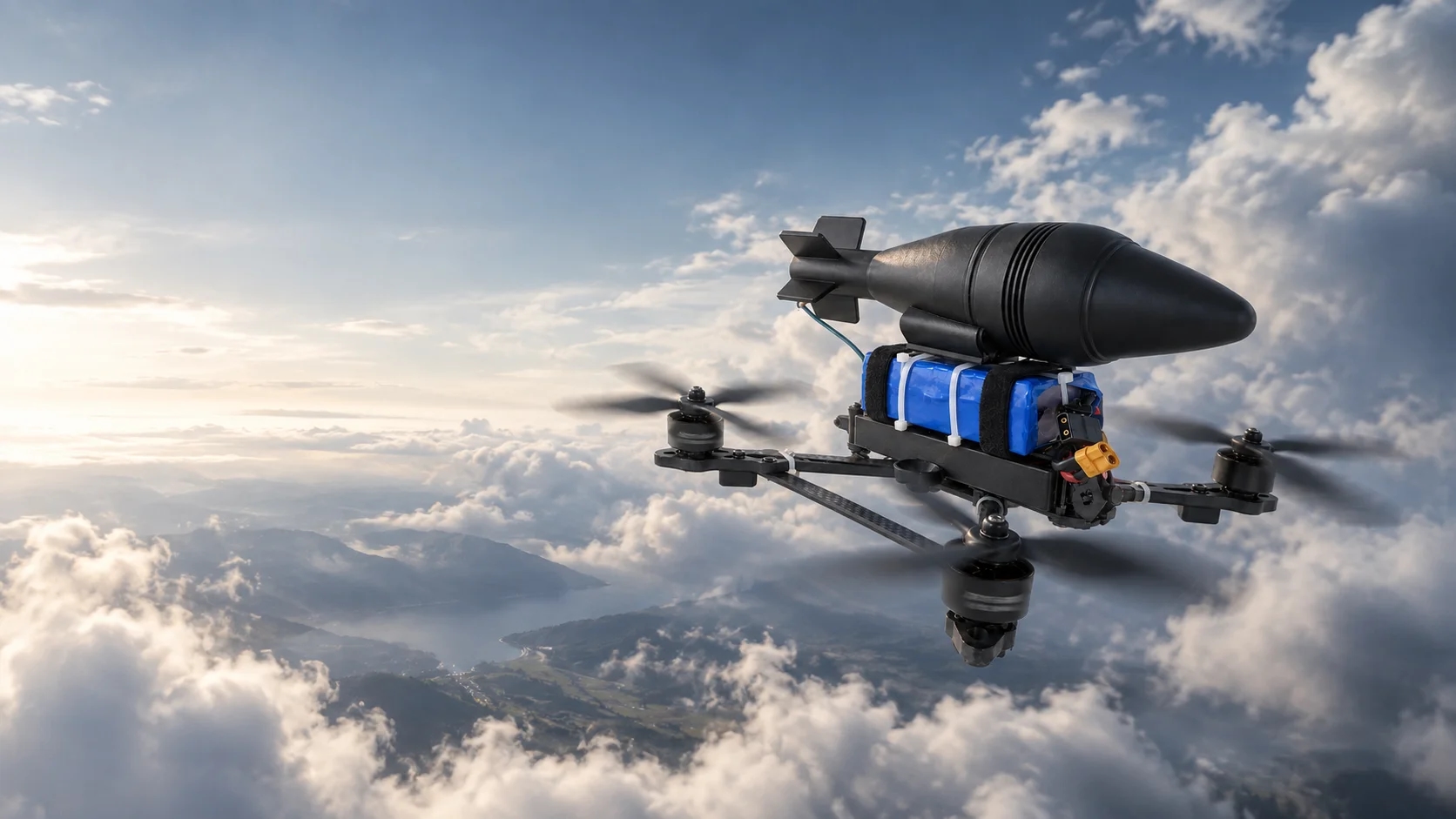
Shark Tiger 7
The compact configuration for missions that require a smaller airframe and greater maneuverability.
- 7-inch airframe class
- Mission planning and control through Shark GCS
- Detailed performance figures available on request

Unmanned aircraft
Shark Tiger can switch between manual FPV flight and autonomous missions. Multiple aircraft can be managed together through Shark GCS.
Shark Tiger is an unmanned quadcopter platform available in 7-inch and 10-inch configurations. Both support manual flight and operator-supervised autonomous missions.
The onboard camera supports manual first-person view (FPV) flight. With Shark GCS, operators can plan and monitor missions, cancel an active mission, and command the aircraft to return safely.
Multiple Shark Tiger aircraft can connect to Shark GCS at the same time. Operators can view their position, status, and telemetry from one screen.
Operators can fly Shark Tiger manually using a controller and the onboard camera. This mode suits missions that require continuous manual control.
Autonomous missions are planned and started through Shark GCS. Operators continue to monitor the flight and can intervene when needed.
If conditions change, the operator can cancel the active mission and command the aircraft to return safely. Planning, flight monitoring, and intervention use the same interface.
Multiple Shark Tiger aircraft can connect to Shark GCS at the same time. Operators can track the status, telemetry, and movement of each aircraft through one interface.
Aircraft positions can be assigned or updated during the mission, allowing the fleet to operate under one coordinated plan.
Shark Tiger 7 and Shark Tiger 10 use the same Shark GCS interface for Coordinated Fleet Operations.
For institutional projects, selected flight control, propulsion, communications, imaging, and mission electronics can be configured to meet project requirements. Shark GCS remains the common ground control platform.
Shark Tiger 7 is the compact configuration, while Shark Tiger 10 is the larger option. Both support manual flight, autonomous missions, and fleet control through Shark GCS.
The compact configuration for missions that require a smaller airframe and greater maneuverability.
The larger configuration, with published performance and system specifications.
Published figures apply to Shark Tiger 10.
| Parameter | Value |
|---|---|
| Maximum speed | 100 km/h |
| Endurance | 22 min |
| Service ceiling | 2,000 m AMSL |
| Operational range | 5 km |
| Parameter | Value |
|---|---|
| Airframe options | 10 in |
| Payload capacity | 3 kg |
| Parameter | Value |
|---|---|
| Propulsion | High-thrust propulsion system |
| Navigation | GNSS / INS |
| Communication | Encrypted multi-band broadband |
| Operating temperature | −25°C – +55°C |
Shark Tiger combines Shark Aviation flight control, propulsion, communications, and ground control systems in one platform.
Using a common system architecture simplifies integration between the aircraft and the operator console.
Shark SkyLine FCU Series
Flight control for aircraft stability and mission commands.
Shark Link
Data link between the aircraft and the ground control station.
Shark GCS
Mission planning, flight monitoring, and multi-aircraft control.
Shark ESC
Electronic speed control matched to the motors' power and response requirements.
Answers about the platform, its configurations, and operation.
Contact us to discuss configuration options, system integration, and procurement.