
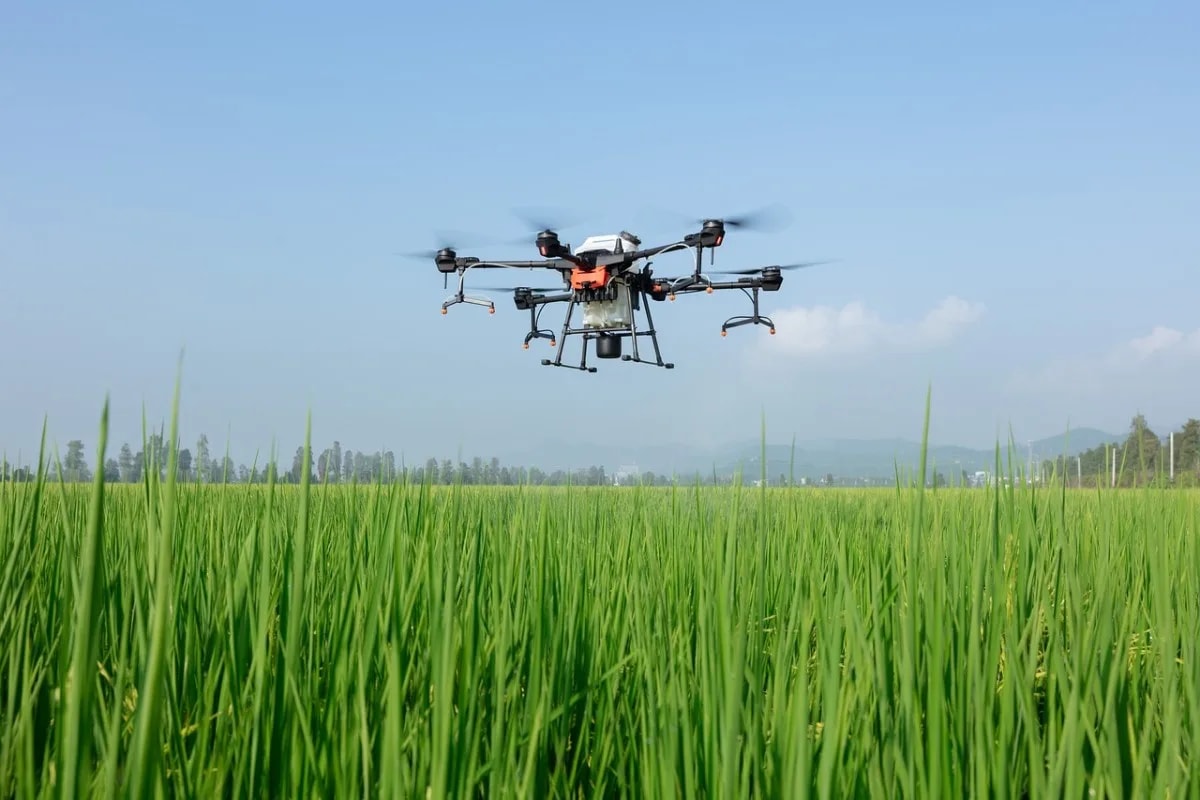
Drones used to spray agricultural land give their operators a real advantage. They save both time and labour, and they help apply chemicals more evenly. Drone spraying is a service that makes farm work easier for landowners.
Treating a field after disease appears is important. Applying preventative chemicals evenly across the land is also an advantage for the landowner in many ways. In cases like these, spraying by drone makes the job easier for farmers.
Drone technology is now used in almost every field. Given the advantages of agricultural drones in particular, these aircraft keep growing more popular for the productivity and practicality they offer.
Advantages of Spraying by Drone
Agricultural drones sit among the capabilities of unmanned aerial vehicles, and they are built with advanced technology. These professional aircraft open the door to modern farming and are relevant to anyone involved in agriculture.
It is well known that operators struggle especially when spraying large fields. With what new technology now makes possible, drone spraying gives landowners an easier time with labour, time, and safety. Some of those benefits can be described as follows:
-
Using plant-protection chemicals evenly. Using too much or too little can harm plants instead of helping them. Spraying by drone is required if you want to apply chemicals the right way. That reduces environmental harm and also lowers cost.
-
Walking the field to inspect a possible disease can itself help the disease spread. A reconnaissance flight with drones lets you observe the land without setting foot on it.
-
There are many types of unmanned aerial vehicles. Some models image fields of 500 dönüm. That makes it easier to identify areas that need spraying, and it also saves time during spraying itself.
-
In traditional farming, people have to enter the field themselves or treat it with a tractor. Compared with spraying by drone, that is both tiring and a disadvantage. Tractor spraying can crush plants. In that case you lower yield while trying to raise it. Tractors are known to damage crops such as maize and wheat especially during weed control. Disadvantages like these can be turned into advantages by doing the work with a drone.
Who Can Use Agricultural Drones?
Agricultural drones, which offer high ecological and economic benefit, are used by agricultural engineers, technicians, farmers, local authorities, and agricultural input producers.
Types of Agricultural Drone
Agricultural drones used on farmland are offered both as multi-rotor and as fixed-wing aircraft. Multi-rotor drones are easier to operate than other types.
Sensors on the drone, together with cameras that can capture and transmit digital imagery, make it easier for people working in agriculture to collect richer, higher-quality images and data from the field.
Yield from Drone Spraying
Spraying with traditional methods (tractor or manual labour) yields around 40%. Drone spraying raises that figure to as much as 90%. Traditional spraying also wastes a great deal of chemical. That causes financial loss and harms the environment. Spraying with a drone saves about 35–40% of the chemical.
Time savings are another point. With traditional methods you can spray an average of 300 decares in a day, while a drone can cover 800 decares. Agricultural spraying can also be harmful to health. When you spray by drone, you are protected from those downsides as well. Drones can deliver the highest available return in time, money, safety, and health.
How Is Drone Spraying Done?
-
First the farmland is surveyed with a preliminary drone flight.
-
Disease status, irrigation effectiveness, and plant development are observed, and gaps are identified.
-
The chemicals needed for the field are prepared to the per-decare doses set by the manufacturers, then loaded into the liquid tanks on the drone.
-
Finally the drone is flown and, using GPS, the entire field is sprayed evenly, pass by pass.
How Many Litres Does an Agricultural Spray Drone Carry?
An agricultural spray drone can be chosen according to the size of the fields to be treated. These drones therefore have liquid tanks of different capacities. The agricultural spray drones commonly used today are produced with 10-litre, 20-litre, and 30-litre tanks.
Soil and Field Analysis with an Agricultural Drone
One of the jobs done with an agricultural drone is soil and field analysis. This makes it easier to monitor large-scale crops and planting areas. In previous years, satellites and aircraft were used to get a wide view so known problems could be identified. Drones are more precise and more economical than those platforms. Agricultural drones also provide real-time imagery. They can produce real-time animations of crop development as well, and they help protect the plants.
Agricultural drone types can produce a three-dimensional map of the soil. They also let users inspect soil quality, nutrient management, or dead patches of ground in detail. Information like this helps farmers plan sowing, crop management, soil and plant analysis, and plant protection — and take more yield. Continuous monitoring by drones also supports better use of water and more effective management of crop nutrient levels.
Spraying and Irrigation with an Agricultural Drone
Crops grown on farmland return a harvest to the farmer when they are fertilised and sprayed regularly. In traditional methods these jobs are done by human labour or farm machinery. Those methods have many disadvantages in cost, labour, and time.
When spraying by drone, a special capsule filled with fertiliser, herbicide, or pesticide is placed in the aircraft, depending on the model. Every point that needs treatment is therefore both fertilised and sprayed. The agricultural drones used for this work can be flown independently or run on dedicated programs and routes.
Alongside these advantages, agricultural drones are a very practical method for anyone aiming at long-term economy.
Traditional farm machinery is known to save 30% of chemical. With agricultural drones that figure rises to around 40–45%.
The effect of traditional spraying on the crop is 40%, while the effect of agricultural-drone spraying on the crop has been measured at 90%. Agricultural drones also save 20% more water.
Irrigation or spraying on farmland is quite laborious. Identifying the area that needs water is also an important parameter. These specialised drones are equipped with multispectral cameras. They therefore track moisture levels and identify patches of soil that need irrigation.
Is Drone Spraying Effective?
Agricultural drones are advanced-technology aircraft used to increase crop yield, monitor plant growth, and optimise farm operations. Drone spraying deposits agricultural chemicals on the soil evenly. That delivers a high level of effectiveness against disease or harmful pests.
Which Problems Does an Agricultural Drone Detect?
Some of the problems unmanned aerial vehicles detect on farmland are as follows:
-
Soil variation
-
Irrigation problems
-
Pest or fungal infestation
Healthy and unhealthy plants in the field are identified by drones through multispectral imagery. That helps the farmer assess the crop. With agricultural drones, plants or the land itself can be inspected at any time of year.
These aircraft, built with advanced technology, include a near-infrared and visual spectrum view. Through those images the farmer can see problems in the soil or the productive areas. Just as with spraying by drone, they also make problem detection easier for the user.