
Shark Blue Mini is a compact, fixed-wing unmanned aerial vehicle (UAV) developed for autonomous missions and coordinated multi-aircraft operations. The system combines the aircraft, mission software, communications, and ground control functions in one operating architecture.
Shark Aviation develops the programme through design, testing, integration, and flight demonstrations. Each stage produces the technical data needed to refine the aircraft and its control architecture.
A portable fixed-wing platform
Field deployment depends on more than flight performance. Teams must also be able to transport, assemble, launch, and support the aircraft without extensive infrastructure.
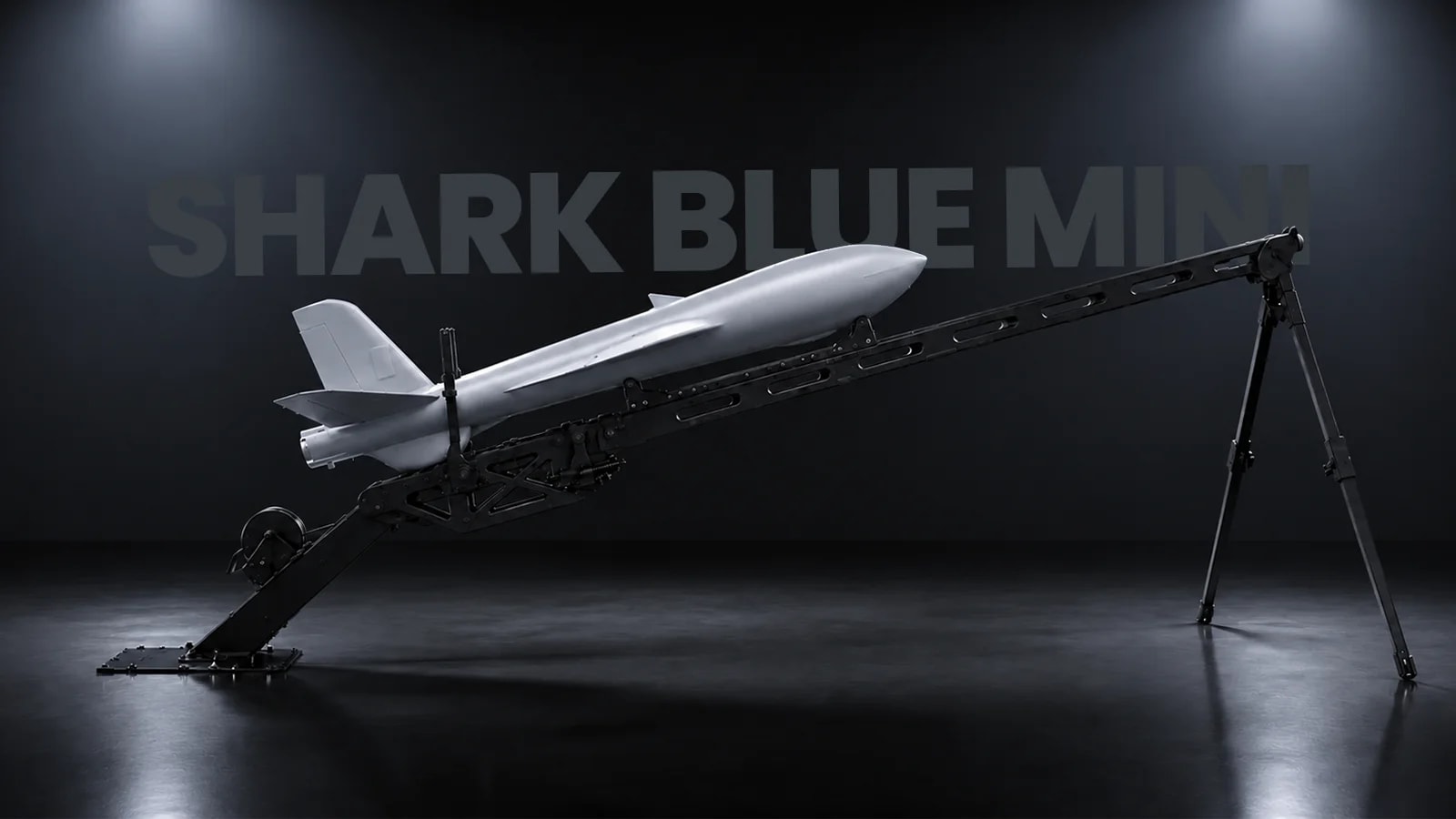
Shark Blue Mini has a detachable airframe with a published wingspan of 1,320 mm and fuselage length of 850 mm. The wings and fuselage fit into a dedicated transport case and can be assembled near the launch area.
The compact format reduces transport space and the equipment needed to prepare the aircraft. It also allows teams to move launch positions as mission requirements change.
One operator can control multiple UAVs
The system is designed around one operating principle: one operator controls several aircraft through a shared ground control station (Shark GCS). The aircraft exchange mission data, coordinate their movement, and carry out assigned tasks within a common flight plan.
The architecture is being developed to support:
- Multi-aircraft mission planning: One control environment assigns and monitors tasks
- Shared mission data: Aircraft exchange operational information during flight
- Coordinated flight: Automated functions manage formation and route coordination
- Modular integration: Software functions and payloads can be added for specific requirements
The operator supervises the mission and retains authority over key decisions. Automation manages repeatable navigation and coordination tasks rather than requiring manual control of every aircraft movement.
The next test stages will evaluate this control model with multiple aircraft under defined mission conditions. Those results will show how the architecture performs beyond the current development environment.
Modular architecture and planned development
Communications, sensors, navigation, and mission software do not develop at the same pace. Shark Blue Mini therefore uses a modular architecture intended to accept new functions without replacing the complete aircraft.
Published development areas include advanced telemetry, additional payloads, artificial intelligence-supported mission logic, and operation with limited or unavailable satellite navigation signals. These are development goals unless supported by completed test or qualification data.
The distinction matters. A roadmap describes what the programme intends to develop; test evidence shows what a specific configuration has achieved. Buyers and integration partners need both, but they should not be presented as the same thing.
Published development specifications
Shark Blue Mini is still in development. Published figures describe the programme's current targets and configurations, not a final production specification.
Programme materials report:
- Up to 60 minutes of endurance
- Operation beyond 20 km
- Approximately 311 g (11 oz) of payload capacity
- Mission effects at reported ranges of 30 to 40 km
The selected configuration, payload, and operating conditions will determine the figures relevant to a specific requirement.
Operator authority and recovery
The control architecture is being designed to let the operator interrupt a mission, cancel payload activation, and command autonomous landing and recovery while the aircraft remains connected.
These functions preserve human authority during the mission. They also allow recovery when the mission changes or the operator decides not to continue. When conditions permit, the aircraft can then be reused for testing, training, or another operation.
Intended applications
Shark Blue Mini is being developed for missions that require a portable aircraft, coordinated control, and configurable payloads. Potential applications include reconnaissance, observation, border protection, critical infrastructure security, and training.
The aircraft's final role depends on its payload, communications package, legal framework, and the customer's testing and qualification process. The programme does not treat every proposed use as an already demonstrated capability.
Shark Aviation's work also covers engineering, integration, testing, training, and technical support. The aim is to support the system beyond individual demonstrations.
Development and testing ahead
Each planned test will produce data for the next airframe configuration, software release, communications layer, and mission scenario. The programme will use defined test conditions to assess autonomous flight, multi-UAV control, precision, and recovery functions.
The next step is to establish repeatable configurations, documented interfaces, training procedures, and support arrangements. This work will determine how the development platform progresses towards an operational system.
To discuss Shark Blue Mini requirements, integration, or demonstrations, contact Shark Aviation.