
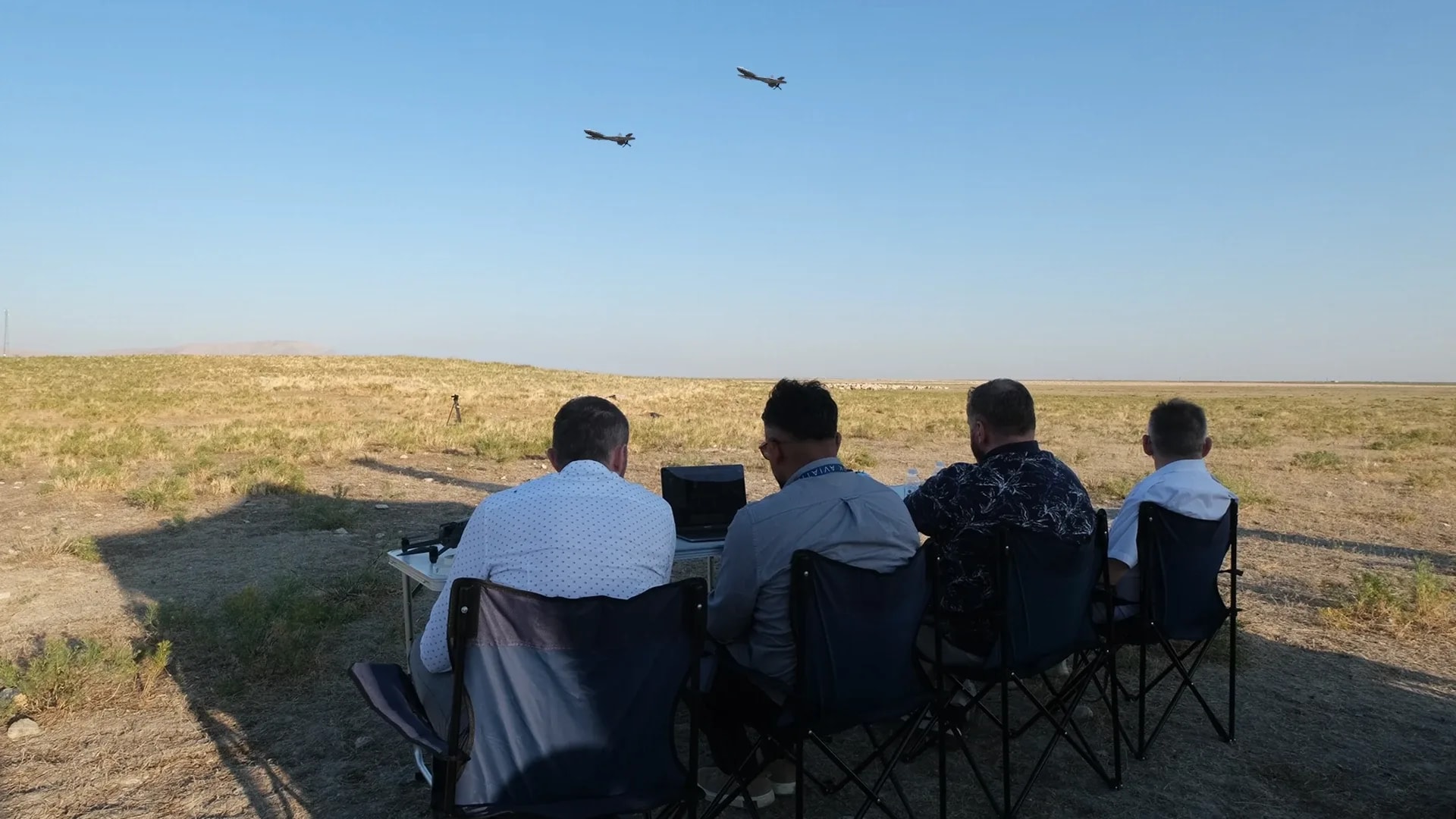
Shark Aviation completed Phase I testing of Shark Blue Mini in Konya, Türkiye, on 19 July 2026. The prepared scenarios covered autonomous flight, multi-aircraft control, recorded flight performance, mission interruption, and aircraft recovery.
The event tested the aircraft as part of a complete operating system. It brought together the unmanned aerial vehicles (UAVs), mission software, communications, and Shark Ground Control Station in one test environment.
What Phase I tested
Five prototype aircraft took part in the test programme. They represented the current development configuration, not a final production model.
The scenarios examined:
- Autonomous flight: Execution of a planned mission profile
- Multi-UAV control: Simultaneous management of two aircraft through one ground control station
- Communications: Connection between the aircraft and operator during the mission
- Flight performance: Speed, distance, and flight time under the test conditions
- Mission control: Interruption, payload cancellation, landing, and recovery procedures
The team reported that all planned Phase I scenarios were completed. The results provide a baseline for later development and testing.
Autonomous mission over approximately 26 km
One scenario covered an autonomous mission profile of approximately 26 km. The aircraft followed the assigned route and mission sequence while remaining connected to the control system.
Autonomous operation involves more than maintaining altitude or following a straight path. Navigation, mission sequencing, telemetry, and operator oversight must work together. The aircraft must also respond predictably if the operator changes or ends the mission.
The 26 km figure describes the prepared Phase I scenario, not the platform's maximum range. Other programme materials refer to operation beyond 20 km and a separate flight-test campaign exceeding 30 km. These results come from different flights and conditions.
Two UAVs controlled by one operator
During Phase I, one operator managed two Shark Blue Mini aircraft simultaneously through a single ground control station. This test demonstrated the current basis for coordinated multi-UAV operations.
The shared control environment combines mission planning, telemetry, aircraft status, and intervention controls. Automation manages repeatable navigation and coordination tasks while the operator supervises the mission and retains decision-making authority.
Two-aircraft control is not the same as a fully scaled swarm. Further testing is required as the number of aircraft, payloads, communication demands, and mission variables increases.
Recorded flight performance
The demonstration flight lasted approximately 18 minutes. The aircraft recorded a cruise speed of about 99 km/h and a maximum indicated speed of 146 km/h.
These measurements apply to the aircraft configuration and scenario used in Konya. They should not be combined with the highest endurance or range figures from separate tests. Flight time, range, speed, payload, weather, and reserve requirements affect one another.
Programme materials also report endurance of up to 60 minutes. That value and the shorter Konya flight describe different mission profiles and test conditions.
Precision results came from separate tests
The Konya programme included precision scenarios, which the team reported as completed. Separate trials in the wider development programme had previously recorded approximately one-metre guidance accuracy.
Those earlier trials also reported an airburst about five metres above the ground, with observed effects across an area roughly 30 metres in diameter. These measurements should not be attributed to the Konya event. They apply only to the trials and configurations in which they were recorded.
A successful demonstration confirms performance under defined conditions. Repeatability, qualification, and customer acceptance require further testing.
Mission abort and aircraft recovery
Phase I also tested the operator's ability to interrupt a mission. Reporting from the event states that the operator could cancel payload activation and direct the aircraft into an autonomous landing and recovery sequence without losing the control connection.
These functions allow the operator to respond when conditions change or a mission should not continue. Recovery also returns the prototype with its recorded data so the engineering team can inspect it, make changes, and test it again.
Automation supports flight and coordination, but the operator retains the authority to intervene and end the mission.
What the results confirm
Phase I confirmed that the tested Shark Blue Mini prototypes could:
- Complete the prepared autonomous mission profile
- Operate two aircraft through one ground control station
- Record defined flight-performance data
- Maintain operator intervention during the mission
- Enter an autonomous landing and recovery sequence
The tests establish a working baseline, not a finished qualification programme. Swarm scaling, communication resilience, payload integration, repeatability, and customer-specific qualification remain subject to further engineering and evaluation.
To discuss Shark Blue Mini testing, integration, or demonstration requirements, contact Shark Aviation.